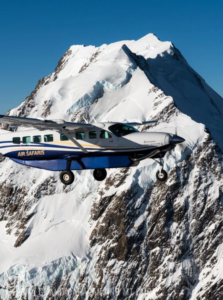
Air Safaris is best known for scenic flights across the Southern Alps, but its experience goes well beyond tourism. The family-owned business has been operating since 1970 and, under owner-operator Tim Rayward, has supported some very different aerospace projects using the unique conditions and operating environment of the Mackenzie.
We recently sat down with Tim, a member of the South Canterbury Aerospace Strategy Group, to understand that experience and what it could mean for future aerospace opportunities in the region.
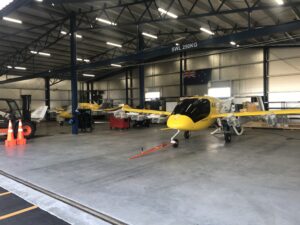
Air Safaris has supported projects including Google’s Project Loon, which tested high-altitude balloons for remote internet access, and Zephyr, now part of Whisk, which has been testing fully autonomous, battery-powered aircraft as part of the pathway towards certified aircraft and commercial customers.
These projects demonstrate the Mackenzie’s potential as a testing ground for new aerospace technology.
Both projects approached Air Safaris after carrying out their own due diligence on potential locations. Key considerations included weather, available airspace, remote operating areas and the ability to conduct testing without disrupting commercial aviation.
The lack of controlled airspace around Lake Tekapo is a particular advantage. UAV and autonomous aircraft testing requires space to operate at different locations and altitudes, while avoiding interference with commercial operators.
The Mackenzie also offers a high number of clear days. Low cloud is a significant advantage for visual flight testing, although wind remains an important consideration.
Tim’s experience as an owner-operator is another part of the equation. Air Safaris has the operational knowledge to work within a busy aviation environment, while its relationships with other local operators provide flexibility when testing requirements change.
Local operators have been able to coordinate around testing activity, allowing normal commercial operations to continue alongside aerospace projects. Air Safaris has also provided chase aircraft for testing where autonomous aircraft have travelled beyond visual line of sight.
This existing aviation expertise, combined with a collaborative approach between operators, is a significant advantage for the region’s aerospace ecosystem.
New Zealand’s adaptable and internationally recognised Civil Aviation Authority framework is another part of the equation, providing a pathway towards certification that can support international markets.
Aerospace projects can start small and develop as testing progresses. Infrastructure created for one project can also support the next.
For Project Loon, this included infrastructure for remote balloon launches, initially using helium before transitioning to hydrogen, as well as hydrogen storage. A climate-controlled hangar was later purchased to manage the Mackenzie’s hot and cold conditions.
Some of this infrastructure was subsequently used by Whisk, demonstrating how capability built for one project can create opportunities for others.
Project Loon had a team based in the Mackenzie for a number of years, with local employees involved in the project. The district’s tourism offering also provided an opportunity to attract team members for longer-term relocation or periods of a project.
For specialist aerospace teams, the ability to combine work in a remote testing environment with direct access to the Mackenzie’s outdoor pursuits, key tourism destinations and village lifestyle can be an additional advantage when attracting people to the region.
The local community has also been supportive of projects operating in the district, helping create the relationships needed to make this type of testing work.
Tim’s experience highlights the practical capability already operating in South Canterbury and the role businesses can play as aerospace innovation develops.
With increasing activity in autonomous, hydrogen- and battery-powered aircraft, alongside larger agricultural drones moving further into the aerospace sector, opportunities for testing and commercial development are growing.
As a member of the South Canterbury Aerospace Strategy Group, Tim is also contributing to work exploring how the region can participate in the sector under the Waitaha Aerospace Strategy.
The experience Air Safaris has already built provides a strong foundation as new aerospace technologies move from development and testing towards commercial scale, both in New Zealand and internationally.